
tabpfn 8.4.0, tabpfn-client 0.4.2, the latest shipped TabPFN API release, and tabpfn-extensions 0.6.0. During this time, we’ve also introduced TabPFN Cookbooks and Research Applications, sharing how TabPFN can be applied for specific use cases. Check them out—and contribute your own.
Open-source package
tabpfn 8.4.0 ships with improvements across regression, fitting performance, and Apple Silicon inference:
- Better uncertainty estimates for regression. Made for forecasting, risk estimation, and other workflows where interval quality matters alongside point predictions.
TabPFNRegressorcan now calibrate its ensemble distribution against held-out data using NLL or CRPS, improving probabilistic outputs and predicted quantiles (#1172). - Faster, lower-memory fitting on large datasets. Made for large or wide datasets—we’ve cut transient memory use and fit time by roughly two-thirds in benchmarks on a 5.3 GB numeric table. The data-cleaning path now avoids redundant float64 copies, assembles encoded arrays in place, and performs pandas dtype casting more efficiently (#1173).
- Local inference on Apple Silicon. When running TabPFN on a Mac, you can now use MPS inference with MLX-backed FlashAttention and autocast, along with fixes for out-of-memory recovery and incorrect linear-layer outputs.
n_estimatorsnow defaults to"auto"(#1171).- Calibrated regression now fails explicitly for batched predictions instead of returning uncalibrated results (#1172).
- DDP fine-tuning now distributes estimator activations across available GPUs. Read the fine-tuning docs.
- Regression now supports batched inference (#1164).
RelArena-α, TabPFN-Rel, and RPI
This week, we released RelArena-α alongside a family of open-source tools for prediction tasks over relational data. The full benchmarking framework and accompanying tools are described in the technical report. Read why we’re focusing on relational.- Compare relational models under a shared evaluation protocol and run benchmarked methods on your own relational data. RelArena-α standardizes data loading, tuning, and evaluation across relational learning tasks, making results easier to reproduce and compare. The Relational Predictive Interface (RPI) provides a common interface for applying these methods to real-world prediction tasks.
- Apply TabPFN to relational prediction tasks. TabPFN-Rel is a relational harness for TabPFN-3 and TabPFN-3-Plus, and is currently the No. 1 model submission on RelArena-α. Get started with the TabPFN-Rel cookbook.
tabpfn-client and API
tabpfn-client 0.4.2 and the TabPFN API ship with improvements across repeated inference and integrations:
- Up to 10× faster repeat inference with KV cache. Best for large prediction volumes against the same training data and long-running interpretability workloads.
fit_with_cachecan now be requested duringfit()throughtabpfn-client0.4.2 and the hosted TabPFN API, reusing the training-set computation so subsequent predictions avoid the full forward pass and can run in under a second. Get started with KV cache.
- TabPFN-3-Plus, including Thinking mode, can now run on Azure AI Foundry through a new estimator interface. Get started with Azure AI Foundry.
output_type="full"now returns a consistent response type.- Asynchronous fitting is now available through
tabpfn-client0.4.2 and the hosted TabPFN API, improving reliability. See the API reference. - The MCP integration now supports asynchronous operations and the standard authentication path. Read the MCP docs.
Extensions
tabpfn-extensions 0.6.0 ships with improvements across interpretability and client compatibility:
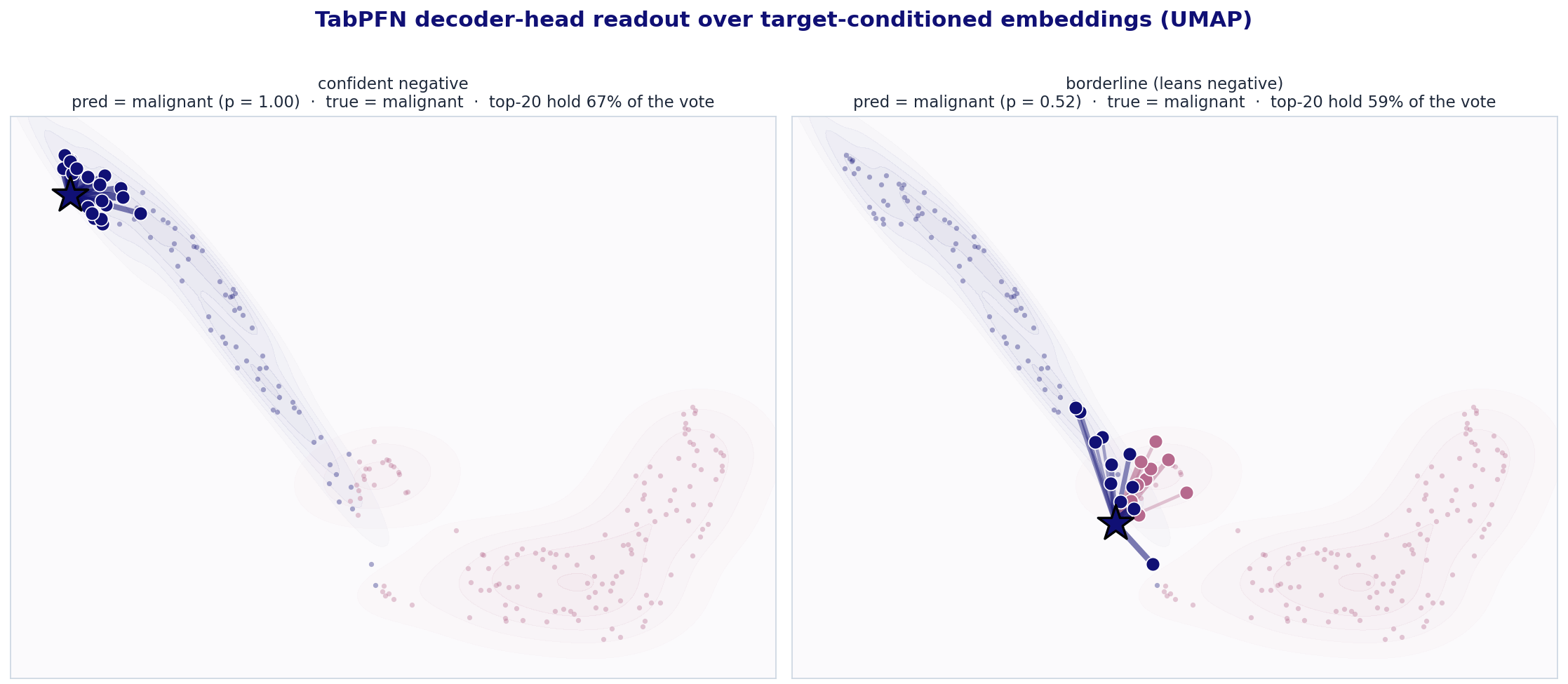
- See which training rows drive a prediction. Best for explaining borderline multiclass predictions, investigating unexpected outputs, and seeing how the training set affects results. The same readout can be viewed in target-conditioned embedding space or in the original feature space (#1142).
- The client-backed regressor now preserves
output_type="full"and forwards requested output types correctly (#354).
Migrating
Review these behavior changes, deprecations, and removals before upgrading production code.OSS (local / Hugging Face)
- Review
n_estimatorswhen upgrading: it now defaults to"auto", feature-coverage scaling applies only to"auto", and an explicit integer is used exactly as provided. Replaceauto_scale_n_estimators, which is deprecated and scheduled for removal in the next major release. - If you calibrate regression with
tuning_configand need to score a batch of datasets, callpredict()on each dataset individually:predict_batcheddoes not support calibrated regression and now raisesNotImplementedErrorinstead of returning uncalibrated fused-batch predictions. - Use PyTorch 2.6.0 or newer for MPS inference.
Extensions
- Include every feature in the
dagmapping passed toTabPFNUnsupervisedModel.generate_synthetic_data()orimpute(); declare parentless features with an empty list.
API
- Reinstall the MCP integration to pick up the latest changes.