                                                                     address  \
36208  5, 6/1, Opposite, Indicash ATM, Sri Ram Temple Road, Ejipura, Bang...
7166   Shop 26, Opposite Gopalan Innovation Mall, 2nd Stage, Bannerghatta...
3598   1st Floor, Sai Charan, Opposite Narayana PU College, Behind Ravind...

                     name online_order book_table  votes  \
36208    Assi Tussi Lassi          Yes         No     27
7166   Udupi Thaja Thindi          Yes         No     42
3598          Food Theory           No         No     88

                                  phone   location      rest_type  \
36208                    +91 9066331614    Ejipura  Beverage Shop
7166   080 26684932\r\r\n+91 9448180376        BTM    Quick Bites
3598                     +91 9108491095  Bellandur            NaN

                             dish_liked  \
36208                               NaN
7166   Masala Dosa, Vada, Filter Coffee
3598      Pasta, Tandoori Roti, Brownie

                                                          cuisines  \
36208                              Beverages, Fast Food, Ice Cream
7166                North Indian, South Indian, Chinese, Fast Food
3598   Biryani, North Indian, Italian, Chinese, Sandwich, Desserts

       approx cost(for two people)  \
36208                        200.0
7166                         250.0
3598                         500.0

                                                                reviews_list  \
36208  [('Rated 5.0', 'RATED\n  Had been there after a tiring day at work...
7166   [('Rated 3.0', "RATED\n  Ate butter roti and paneer butter masala....
3598   [('Rated 3.0', "RATED\n  Have been wanting to try this place for q...

                                                                   menu_item  \
36208  ['Sweet Lassi', 'Banana Lassi', 'Mango Lassi', 'Strawberry Lassi',...
7166   ['2 Idli with 1 Vada', 'Rice Bath', 'Masala Dosa', 'Ghee Masala Do...
3598                                                                      []

      listed_in(type)   listed_in(city)  rate
36208        Delivery  Old Airport Road   3.7
7166         Delivery               BTM   2.9
3598         Desserts         Bellandur   3.0
reviews_list:
[('Rated 5.0', 'RATED\n  Had been there after a tiring day at work. Ordrd veg cheese sandwch nd cold coffee jst to kill my hunger as i was very hungry.. I lyk d taste of sandwch as it was bit difrent in taste from the usual veg sandwch wch i eat from juice junction nd i lykd it.. Cold coffee was gud to taste. Overall, i lykd the food.\nHowever, luking at d exaustive menu nd hygiene level wch these guys have in ejipura location, thy shud cum up wid sum dinner options as well as in egipura its hardly to find gud north indian dinner menu at nite spcly for people lyk me who stays in a pg and cnt eat pg food..'), ('Rated 5.0', 'RATED\n  Blueberry blend, Mango lassi and chocolate cold coffee are to die for. Visited couple of weeks back with friends and liked the price point plus the humble stuff. Looking forward to visit again.'), ('Rated 1.0', "RATED\n  So ...I went to this place and ordered a chocolate lava cake ice cream ... Horrible is the word for it ! ...choco lava is supposed to be served hot with cold ice cream ...... It wasn't so here ... Choco lava was hard n not heated at all ...n when the same was reported to the guy who was making it ...he said he heated it but thanda ho gaya ....it wasn't even a little bit warm ..."), ('Rated 5.0', 'RATED\n  Rijusmita D Kashyap Addictive ice creams, tempting and makes me indulge more and more... Definitely a must try everytime - Winters or summers!!! Try dry fruit sundae from here'), ('Rated 4.0', 'RATED\n  Ranging from fresh juices, milkshakes and mouth watering ice creams, I am glad to have ordered from Assi Tussi Lassi. Loving their experiments with food and reaching out to the right taste of us.'), ('Rated 5.0', 'RATED\n  Great milkshakes at great price!!! Love the Belgium chocolate as well as the sandwiches...reasonable price and I love those friendly staffs...'), ('Rated 5.0', 'RATED\n  Even if you are not a cafe person, you will fall in love with this new place! Must Must try!\nGreat food i must admit, not forgetting those supergood milkshakes though.'), ('Rated 5.0', 'RATED\n  Nice decoration on interior design. Variety of ice creams milkshakes and juices. Customer friendly. Quality service. Good musics . Reasonable price.'), ('Rated 5.0', 'RATED\n  Everything is good here. Cost is also less for the quantity they provides. Good Bollywood and Hollywood music and nice staff very friendly...'), ('Rated 5.0', 'RATED\n  The oreo cheese cake shake is possibly the best thing here.. Nice place with good music going on and the staff is friendly and I love it....'), ('Rated 5.0', 'RATED\n  Mango lasso is my personal favourite. A refreshing and tasty flavour. A regular customer here. Lasso prepared here is so fresh and tastes so yum. Friendly staff as well..'), ('Rated 5.0', 'RATED\n  simply to say i loved it..good initiative and even price is reasonable compared with other branded shops...try blue berry blend it is amazing.'), ('Rated 5.0', 'RATED\n  Amazing milkshakes! Better than keventers in my opinion. It costs less too! Lassi and milkshakes are must try here. They are coming up with some offers.'), ('Rated 5.0', 'RATED\n  Love the lassi here, so fresh & tasty. They provide awesome milkshakes and lassi at reasonable price. And they have some extra items to order like burgers & sandwiches'), ('Rated 5.0', 'RATED\n  A small take away destination for delicious milkshakes Lassi and ice creams. All the items I tried from these guys tasted great! Service is good'), ('Rated 5.0', 'RATED\n  Awesome shakes and good quality too.. They have a wide range of desserts and shakes. Recommend to try Oreo Cheesecake shake. They are currently running offers on milkshakes and ice creams')]

menu_item:
['Sweet Lassi', 'Banana Lassi', 'Mango Lassi', 'Strawberry Lassi', 'Dry Fruit Lassi', 'Pineapple Lassi', 'Rooh Afza Lassi', 'Pomegranate Juice', 'Nutty Chocolatty Shake', 'Oreo Cheese Cake Shake', 'Belgium Chocolate Shake', 'Kit Kat Oreo Shake', 'Assi Tussi Lassi Special Cold Coffee', 'Cold Coffee', 'Chocolate Cold Coffee', 'Kit Kat Cold Coffee', 'Butterscotch Fudge Ice Cream', 'Mexican Brownie Ice Cream', 'Gudbud Ice Cream', 'Dry Fruit Sundae Ice Cream', 'Chocolate Fudge Ice Cream', 'Fruit Salad with Ice Cream', 'Fruit Overload Ice Cream', 'Death by Chocolate Ice Cream', 'Corn Grill Sandwich', 'Sweet Lassi', 'Banana Lassi', 'Mango Lassi', 'Mango Banana Lassi', 'Strawberry Lassi', 'Dry Fruit Lassi', 'Pineapple Lassi', 'Rooh Afza Lassi', 'Butterscotch Fudge Ice Cream', 'Mexican Brownie Ice Cream', 'Gudbud Ice Cream', 'Dry Fruit Sundae Ice Cream', 'Chocolate Fudge Ice Cream', 'Fruit Salad with Ice Cream', 'Fruit Overload Ice Cream', 'Death by Chocolate Ice Cream', 'Fresh Lime Juice', 'Ginger Lime Juice', 'Mint Lime Juice', 'Pineapple Juice', 'Watermelon Juice', 'Muskmelon Juice', 'Orange Juice', 'Mosambi Juice', 'Papaya Juice', 'Pomegranate Juice', 'Carrot Apple Pineapple Juice', 'Apple Beetroot Carrot Juice', 'Plain Wheat Grass Juice', 'Lemon Wheat Grass Juice', 'Watermelon Wheat Grass Juice', 'Pomegranate Wheat Grass Juice', 'Orange Wheat Grass Juice', 'Banana Wheat Grass Juice', 'Butterscotch Shake', 'Nutty Chocolatty Shake', 'Oreo Cheese Cake Shake', 'Belgium Chocolate Shake', 'Super Snicker Shake', 'Red Velvet Shake', 'Kit Kat Oreo Shake', 'Alphonso Mango Shake', 'Blue Berry Blend Shake', 'Zesty Strawberry Shake', 'Nutty Vanilla Shake', 'Brownie Shake', 'Banana Shake', 'Chikoo Shake', 'Apple Shake', 'Butter Fruit Shake', 'Assi Tussi Lassi Special Cold Coffee', 'Cold Coffee', 'Chocolate Cold Coffee', 'Strawberry Cold Coffee', 'Oreo Cold Coffee', 'Kit Kat Cold Coffee', 'Jam Toastie', 'Gulkand Toastie', 'Sandwich Toastie', 'Special Veg Toastie', 'Peanut Butter Toastie', 'Cheese Sandwich Toastie', 'Cheese Chilli Toastie', 'Capsicum Cheese Toastie', 'Cheese Gulkand Toastie', 'Milk Chocolate Toastie', 'Chocolate Toastie', 'Corn Grill Sandwich', 'Veg Grill Sandwich', 'Tomato Grill Sandwich', 'Cheese Grill Sandwich', 'Cheese Chili Grill Sandwich', 'Tomato Cheese Grill Sandwich', 'Veg Grill Extra Cheese Sandwich', 'Cheese Tomato+Capsicum Sandwich']

dish_liked:
nan

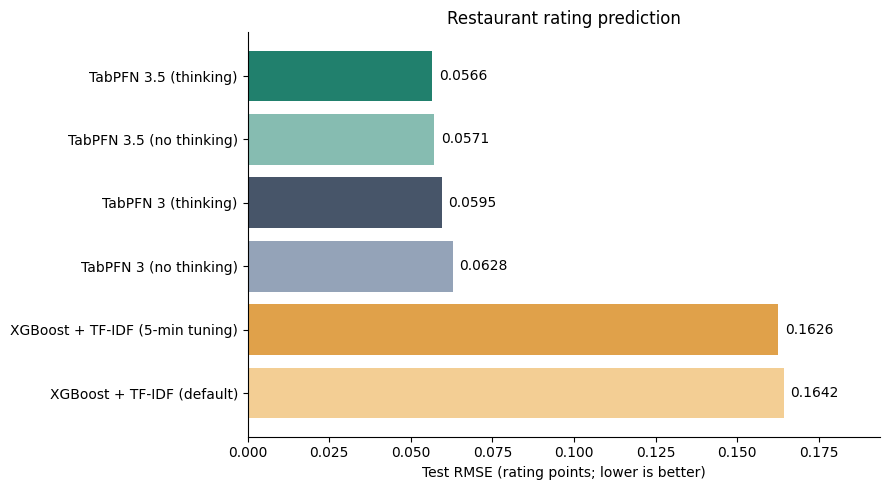 TabPFN 3.5 reduces test RMSE from 0.0628 to 0.0571 rating points compared with TabPFN 3 in standard mode. Thinking improves RMSE for both versions: to 0.0595 for TabPFN 3 and 0.0566 for TabPFN 3.5. Tuned XGBoost reaches 0.1626. These scores describe this listing-level task, where restaurants can recur and reviews contain individual rating scores.